


Sharing memories boosts conservation
Rich with history, educators in a village help pass down heritage protection to younger generations, report Liu Boqian and Yang Jun in Guizhou.
By LIU BOQIAN and YANG JUN | China Daily | Updated: 2026-01-24 10:29


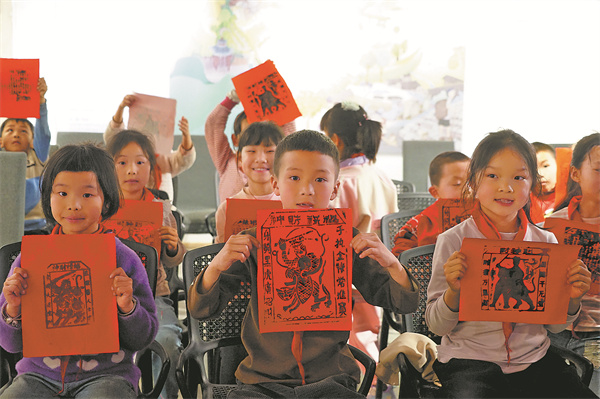
Over the past decade, more children from the academy have gone on to school such as the China Academy of Art. Each year, seven to eight former students return to serve as volunteer teachers, thus passing the torch.
Loushang's approach echoes a broader turn in China's countryside, where shrinking rural populations and the departure of younger generations increasingly affect heritage preservation.
Rural depopulation has reduced the local primary school's roll call, as many families have moved to nearby towns and now return only for festivals. Deng Wenming, the primary school principal, says the Loushang school now has about 80 students, and that number is likely to fall.
Hou, the scholar from Fudan, says he found similar situations in provinces such as Yunnan and Fujian. "This has prompted our efforts to connect cultural transmission with local schooling, shifting attention away from buildings toward practices and memories sustained by remaining communities," Hou adds.
Sustaining Loushang, however, depends on economic opportunity. Local officials say the village does not charge an entrance fee and hosted about 30,000 visitors through group tours in 2025. While significant, this number is relatively low for a tourism village.
Developing tourism and related industries while preserving the village's original character remains unresolved.
"We want to protect Loushang's historic appearance. That is its greatest asset. We hope to use Fudan's connections to attract academic engagement and make it a site for study programs and link it to nearby attractions," says Liu Zhonghua, Party secretary of Guorong township.
Liu Zhonghua emphasizes that development must fit local conditions. "Loushang has accumulated deep academic resources. We can't simply build a commercial street like other ancient towns; we need an overall plan," he says.
He adds that future development must encourage visitors to do more than look at houses and trees. It should foster recognition of Loushang's spirit — its traditions of scholarship and farming — and create cultural resonance between visitors and residents.
Related Stories




Editor's Pick










