


Cracked track may have caused Spain fatal rail crash
By Jonathan Powell in London | chinadaily.com.cn | Updated: 2026-01-26 02:09


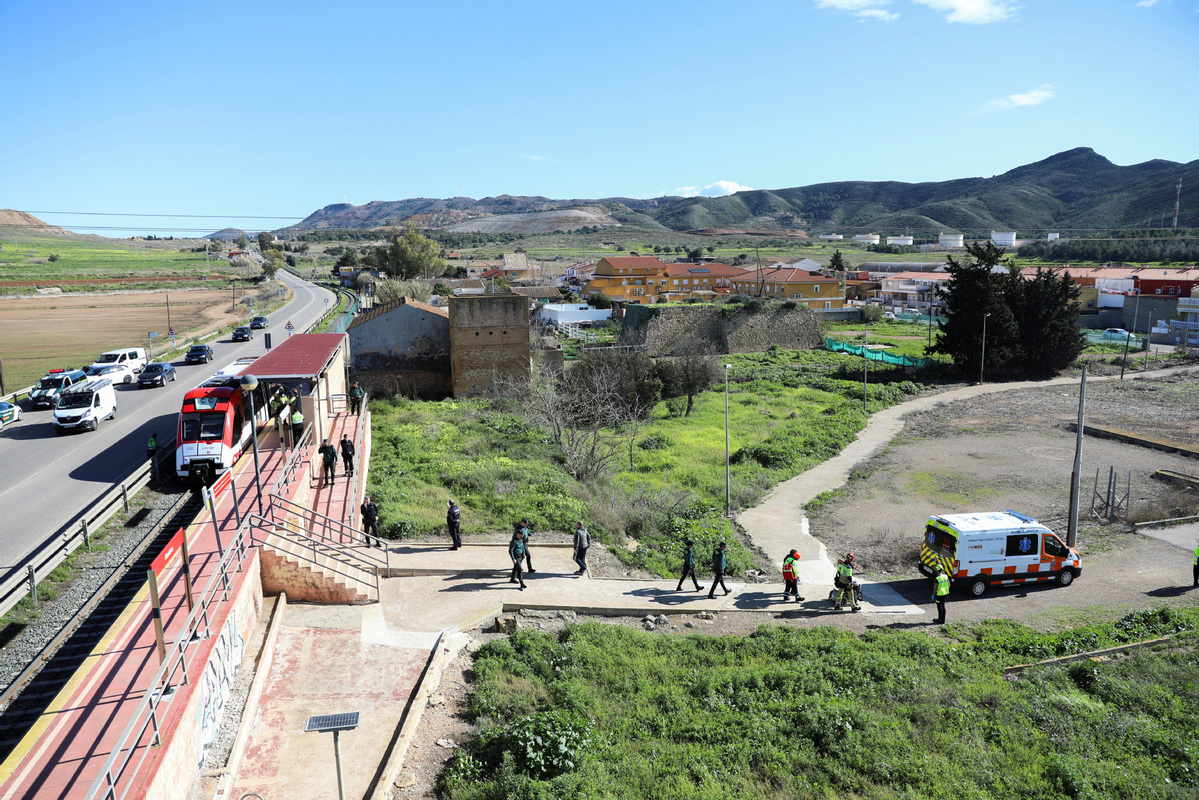
An initial report into the train crash in southern Spain on Jan 18 that killed 45 people says a fracture on the track occurred before the disaster, raising doubts about the safety of the world's second-largest high-speed rail network.
The catastrophe near Adamuz, Cordoba province, happened when a train run by private operator Iryo derailed and its rear carriages shifted onto the opposite track, into the path of an oncoming train belonging to the state-owned rail company Renfe.
The commission for the investigation of railway accidents, or CIAF, said the Iryo train's front cars that stayed on the rails had "notches" on their wheels.
The CIAF said investigators found notches "with a compatible geometric pattern" on the right side wheels of three other trains that ran over the same section in the hours before the crash.
"These notches in the wheels and the deformation observed in the track are compatible with the fact that the track was cracked," it said.
The commission wrote in its report that, based on the information available "we can put forward the hypothesis that the cracking of the track took place before the passage of the Iryo train that suffered the accident, and therefore before the derailment".
It added that "this hypothesis ... must be corroborated by later detailed calculations and analysis".
Investigators are now concentrating on a gap of nearly 40 centimeters in the rail as a central line of inquiry, but the causes for the breakage are yet to be established, the CIAF said, and nothing had been ruled out.
The fatal collision occurred at about 7:45 pm, roughly an hour after the Iryo service left Malaga for Madrid. The train's rear three carriages, cars six through eight, derailed and struck the Renfe train bound for Huelva.
Most of the fatalities and injured were in the front coaches of the state run train.
Speaking in Madrid on Friday, Transport Minister Oscar Puente said: "The conclusions are not final, but they do shed light on the theory that commission technicians currently consider the most plausible."
He added if the fracture proves to be the cause, it likely formed only minutes or hours before the derailment and went undetected because it was too slight to interrupt the electrical current in the track, which would have triggered alarms and halted rail traffic.
The train drivers' union, SEMAF, has called a nationwide strike from Feb 9 to Feb 11, citing repeated safety lapses, after a Barcelona area commuter train struck a collapsed retaining wall on Tuesday.
A trainee driver was killed and dozens of passengers were injured, several seriously, an incident officials linked to heavy rains in Catalonia.
Puente said the two accidents are "completely unrelated" and urged the public not to "question" the rail network, calling it "a great transport system".
The Cordoba rail disaster was Spain's worst since 2013, when 80 people were killed after a train derailed on a curve near the northwestern city of Santiago de Compostela.








Editor's Pick










