New policies seek to boost employment
Plans target key industries, include report on impact of AI on job market
By LI LEI | China Daily | Updated: 2026-01-28 09:04


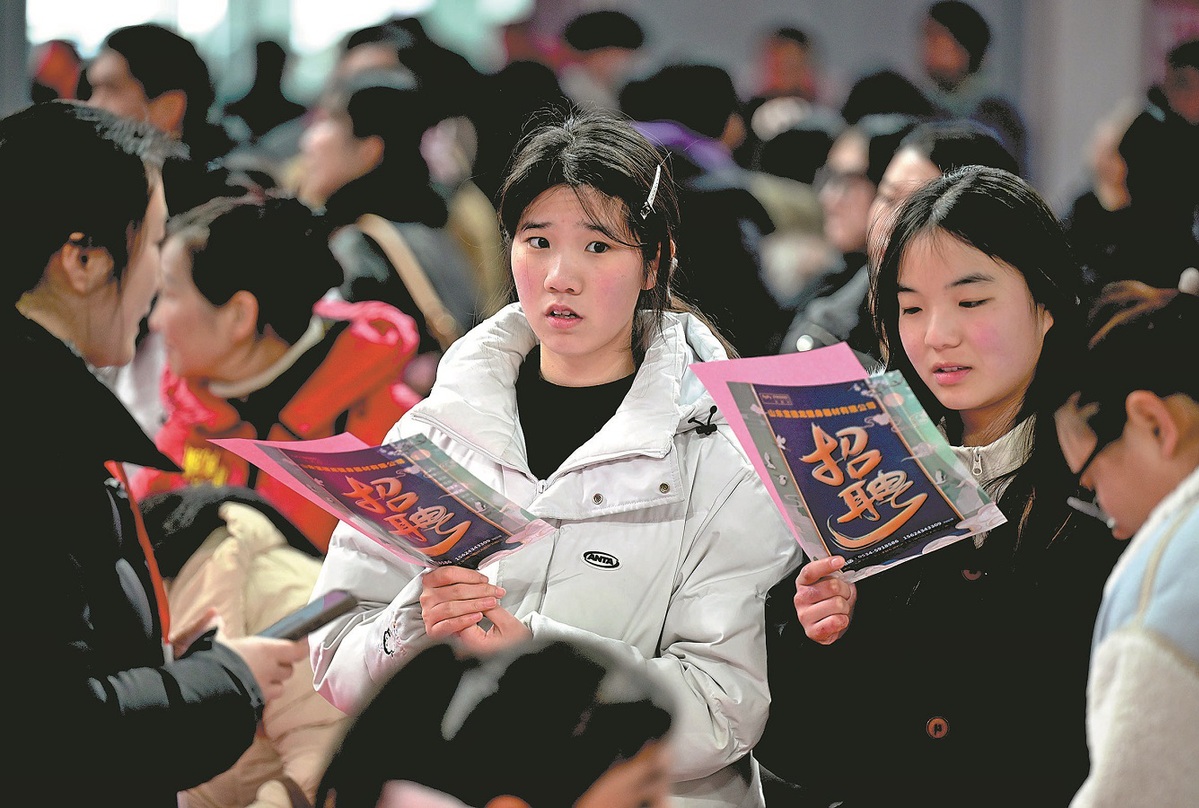
China will heighten employment support policies for key industries and groups, including rolling out a document addressing the impact of artificial intelligence on the job market, the Ministry of Human Resources and Social Security said on Tuesday.
The announcement, made at a news conference, comes as the world's second-largest economy seeks to stabilize employment amid technological disruption and rising global trade protectionism.
Official data showed China's average urban unemployment rate stood at 5.2 percent in 2025, below the government's control target of 5.5 percent. About 12.67 million new urban jobs were created, exceeding the full-year target of 12 million.
The ministry attributed the stability to pro-employment measures introduced last year, including cutting unemployment insurance premiums for employers by 187.2 billion yuan ($26.91 billion) and disbursing 33.6 billion yuan in job stabilization refunds.
Government-led efforts to upgrade skills among groups such as migrant workers, and in sectors including advanced manufacturing and the digital economy, also played a role, it said. Subsidized training sessions covered more than 11 million job seekers.
The results were achieved despite a record 12.22 million college graduates entering the job market last year. The ministry said it organized 210,000 online and offline job fairs offering 10 million positions.
That included a special campaign from Dec 18 to Jan 18 aimed at facilitating employment for the class of 2026 and earlier graduates still seeking jobs.
More than 262,000 employers offered 5.279 million openings, attracting 3.091 million applications and resulting in about 718,000 preliminary matches, said Sun Xiaoli, a deputy director at the ministry in charge of job market oversight.
The campaign targeted sectors such as advanced manufacturing and featured more than 5,000 targeted offline events, while also using digital tools including AI-powered career advisers and livestreamed job fairs.
"The initiative saw robust participation," Sun said.
The ministry pledged to foster an employment-friendly development model and further expand skills training. Planned measures include the AI impact policy, a new five-year employment plan, and broader social insurance coverage for gig and flexible workers.
Zhang Yutian, a deputy director of the employment promotion department, said the ministry will step up job-matching events.
A January-March program targeting migrant workers has been expanded to include registered unemployed and flexible workers. Continued support will also be provided for new graduates through spring recruitment drives and year-end programs, with tailored services for smaller employers.
Innovative formats, including job fairs held in shopping malls, subway stations and evening events, will be introduced.
"We are striving to provide monthly recruitment events, round-the-clock hiring services, and continuous job placement support," Zhang said.
The ministry also highlighted the expansion of occupational injury insurance coverage, which now includes 25.1 million people and has been extended to cover gig workers.
Zhai Tao, a deputy director at the ministry's occupational capacity building division, said five targeted training programs will be launched and new vocational instruction models promoted to enhance workforce skills.
The programs will focus on youth skills, nursing skills for migrant workers, and training for sectors including the low-altitude economy, new energy vehicles and AI, Zhai said.
The ministry will also promote training models designed to better link skills development with industrial demand and workers' income, he added.
A publicity campaign highlighting skilled workers will be intensified, Zhai said, noting that the 48th WorldSkills Competition will be held in Shanghai in September.