Where China's last Tuva dwell
Kanas hosts the only three remaining villages inhabited by an ethnic Mongolian subgroup, which some believe are descendants of a legendary treasure guard, Erik Nilsson reports in Altay, Xinjiang.
By Erik Nilsson | China Daily | Updated: 2026-01-30 06:35


Editor's note: China Daily reporters leverage local expertise to devise diverse itineraries that showcase a blend of historical landmarks and natural wonders in highly recommended cities and sites, offering practical guidance to experience the country.
Kanas more than lives up to its Mongolian name, Beautiful Mysterious Lake. It's a majestic body of water that ripples with riddles, folktales and lore. Legend has it that Genghis Khan led his warhorses to Fairy Bay to drink, hid his treasure at Moon Bay and left a sentinel of elite troops on the shores to guard it.
These soldiers and their descendants are believed to have become the Tuva people. This ethnic Mongolian subgroup of a couple of thousand people is found only in Kanas' namesake village and the two neighboring settlements of Hemu and Baihaba, tucked in the Xinjiang Uygur autonomous region's northernmost corner.
Kanas is also home to a lake monster, Nessie's Chinese cousin; prehistoric petroglyphs that appear to show UFOs; massive footprints said to be left by Genghis Khan or a god; a dead tree that floats in place, unanchored, no matter the current; a lake that glows with an inexplicably milky hue; a holy spring that purifies your eyes; and many other enigmas. Some even contend Genghis Khan's remains sleep upon its bed, and Kanas' aquatic cryptid guards his final resting place.
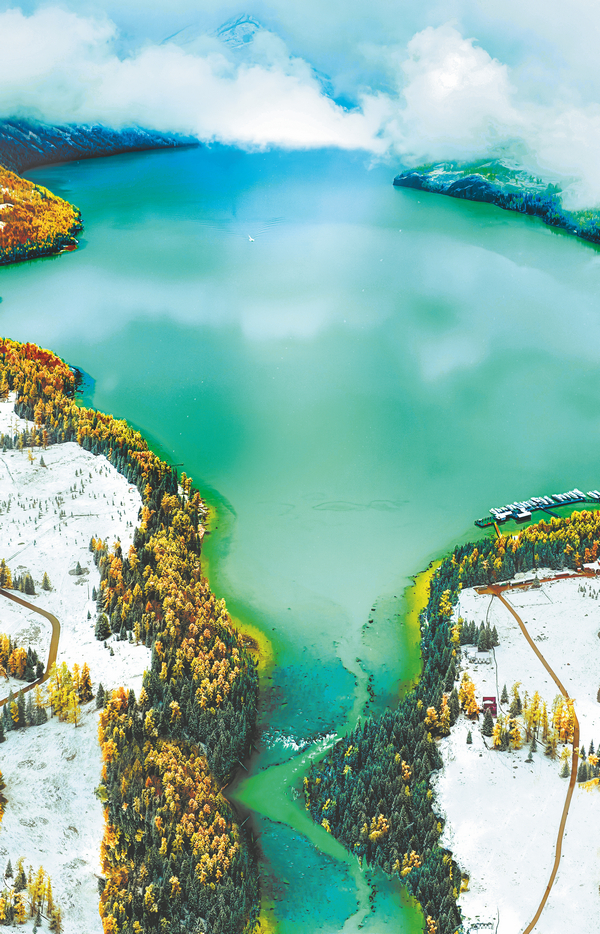
Likewise, Kanas Lake's Fairy Bay, which takes its moniker from its otherworldly mists, also lives up to its other nicknames — the Lake of Kings, Pearl Lake and Color-Changing Lake. Its shades vacillate throughout the year, mostly because of the surrounding foliage's palette. The alps are daubed with shades of green in summer, gold in autumn and white in winter.
Like Genghis Khan's steeds, you can sip directly from the mineral-rich water, which is bottled by the local brand, Xuedu Glacier Spring. It originates from the snowcaps that crown the Altay Mountains that ring around Kanas, especially the Youyi (Friendship) Peak Glacier, whose meltwater trickles into Northwest China's Xinjiang, Russia, Mongolia and Kazakhstan.
The slopes bristle with conifers and birch, and are studded with yurts and vernacular red-pine log cabins that are the pastoral Tuva's summer abodes.
Moon Bay's serpentine oxbow curves are an icon of northern Xinjiang. While its name is supposed to come from its crescent form, it's shaped like an S rather than a C. Symbolically, it's the X that marks the spot on the map where Genghis Khan supposedly stashed his treasure.
These hidden riches may be a myth, but Kanas truly is a gem in itself. It bejewels the natural landscape with a cultural legacy that shines across centuries and the world.
It's a place where reality and imagination swirl together into a single current that flows deep beneath the surface of its waters and our psyches.
Contact the writer at erik_nilsson@chinadaily.com.cn