


Taking Silk Road science global
Experts use advanced research to protect fragile earthen ruins and assist overseas partners, report Wang Ru and Ma Jingna in Dunhuang, Gansu.
By Wang Ru and Ma Jingna | China Daily | Updated: 2026-08-18 08:43


As protection techniques matured, the next frontier was understanding long-term effects of the environment. In 2020, the academy launched a multi-field coupling environmental simulation laboratory for mural and ruin protection.
The lab can simulate temperature ranges between — 30 C and 60 C and relative humidity from 10 to 90 percent, as well as various climatic conditions across all four seasons, including wind, rain, snow, and sunlight for experimental testing. This allows researchers not only to understand a site's present condition, but also to glimpse its past and future, says Guo.
With these systems now well established, the Dunhuang Academy is increasingly taking its conservation expertise abroad. "Cultural heritage is a witness to a country's history, so every nation wants to protect it," says Guo. "Having benefited from international cooperation ourselves, we feel a responsibility to share our experience with counterparts abroad, to help them safeguard their heritage, which actually belongs to all of humanity."
In 2024, the academy signed memoranda with cultural heritage institutes in Uzbekistan, Kyrgyzstan, Sri Lanka, and Cambodia, covering joint site protection, exchanges of theories and techniques, cultural exhibitions, academic activities, and professional training. In 2025, the China-Kyrgyzstan Belt and Road Joint Laboratory on Cultural Heritage Conservation was approved for construction to advance these efforts. "Local people understand their own culture best," says Guo. "We offer techniques and discuss protection ideas together. In this way, we cooperate to protect their cultural heritage."
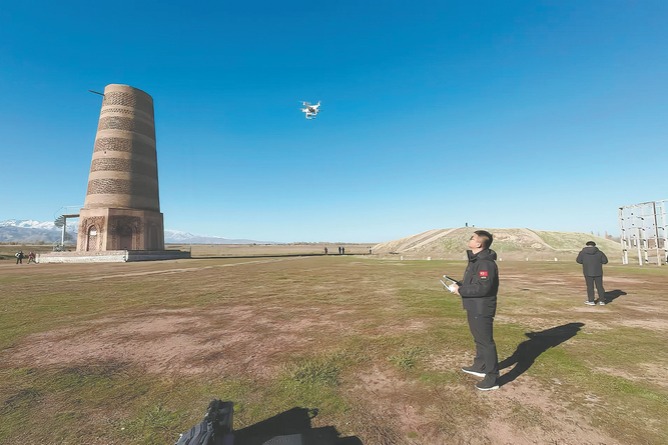
This year, academy professionals arrived at the ruins of the ancient city of Suyab in Kyrgyzstan, a key city on the ancient Silk Road that is now recognized as a World Heritage site, to establish a comprehensive experimental platform for heritage protection.
Aisin Duishanalieva, director of the Republican Inspectorate for the Protection of Historical and Cultural Monuments of the Ministry of Culture of the Kyrgyz Republic, told Global Times earlier that the lab, built under the Belt and Road Initiative, has established systematic research capacity and will continue to develop. "Through this joint collaboration, we can study and excavate cultural relics along the Silk Road and better popularize them in our two countries," she said.
Guo says: "Our academy will remain engaged in domestic and international cooperation, protect grottoes and share their art with an increasingly open approach, and attract more scholars, especially young ones, to join us.
"We will conduct comprehensive, multidisciplinary research on Dunhuang sites in the broader context of human civilization, dig deep into their historical, artistic and scientific value, and contribute to the cultural diversity of the world," he adds.
Related Stories
- Lost painted sculptures donated by Taiwan group go on display in Shanxi
- Xinjiang's Tacheng named 'International Accordion-Friendly City'
- Moroccan events promote Chinese tea, Sichuan culture
- Heilongjiang cultural crafts exhibited at Shanghai book fair
- Jun wares make a splash in new exhibition
- Listen a little close







Editor's Pick










