


Foreign journalists visit Jingdezhen porcelain sites after UNESCO listing
By Zhao Ruinan in Jingdezhen, Jiangxi | chinadaily.com.cn | Updated: 2026-09-02 19:15


Standing beneath a pyramid-shaped digital ceiling in Jingdezhen's Taoyangli historical and cultural district on Monday, a group of foreign journalists looked up at images of Chinese porcelain glowing overhead.
The installation recreates the Porcelain Room at Santos Palace in Lisbon, Portugal. Its ceiling is decorated with 272 pieces of Chinese porcelain, most of them Ming Dynasty (1368-1644) blue-and-white wares made in Jingdezhen.
"The ceiling shows that cultural exchanges between China and the West date back centuries," said Weng Yanjun, director of the Jingdezhen Imperial Kiln Institute.
The Porcelain Room took its present form in the second half of the 17th century, after Chinese porcelain had reached Europe through maritime trade. In 2019, the Guimet Museum in France led a project to digitize and virtually reconstruct the ceiling. The installation was donated to the Jingdezhen Imperial Kiln Museum in 2022 and is now on permanent display at Taoyangli.
The visit was part of a media trip organized by the State Council Information Office from Aug 30 to Sept 2. Journalists from news organizations in the United States, Spain, Italy, Japan, South Korea, Indonesia, and India took part, with the trip focusing on the systematic protection of cultural heritage.
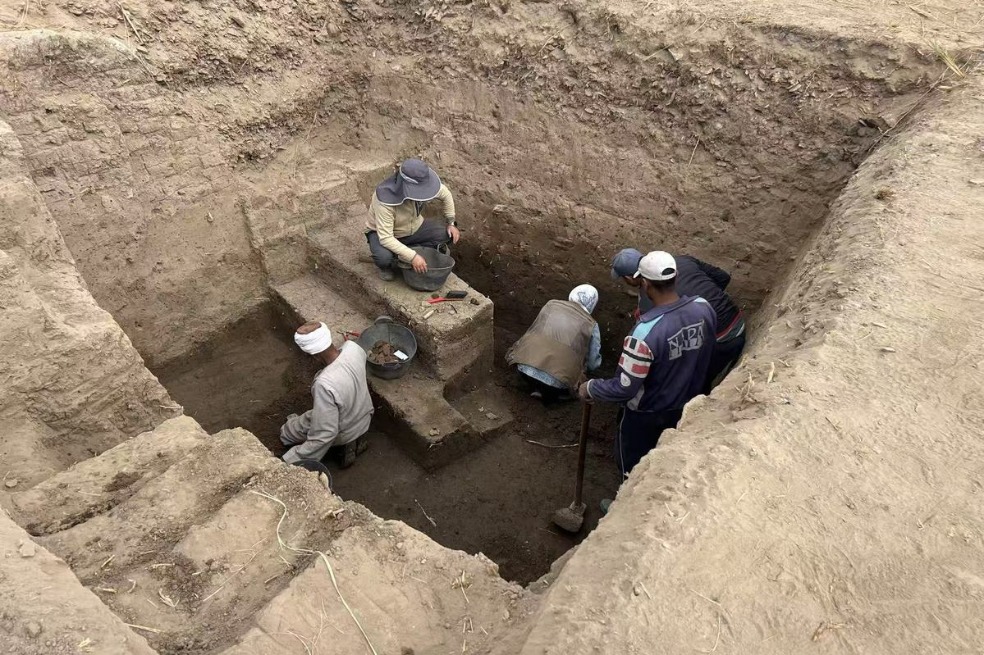
During their stay, the journalists visited the Imperial Kiln Factory, the Hutian Ancient Kiln Site, the Jingdezhen China Ceramics Museum, and Taoxichuan Ceramic Art Avenue. The program covered archaeological research, heritage conservation, traditional porcelain-making techniques, and contemporary ceramic art.
For Desca Lidya Natalia of Indonesia's Antara News Agency, it was her first visit to Jingdezhen. She was particularly impressed by Taoxichuan, where former State-owned ceramic factory buildings have been transformed into studios, galleries, and other cultural spaces.
She said the artist residency programs there created opportunities for Chinese and international artists to work together and exchange ideas.
Irene Morante de la Hera of Spanish news agency EFE was visiting Jiangxi for the first time. She said the trip had been rewarding and had helped her better understand Jingdezhen's ceramic heritage following its UNESCO inscription. The visit reminded her of heritage conservation in Spain, including the preservation of the works of Antoni Gaudi. She said China and Spain could further share their experience in protecting cultural heritage.
Ananth Krishnan of Indian newspaper The Hindu said that before the trip, he had mainly known Jingdezhen for its long porcelain-making history and craftsmanship. He was surprised to discover how many of the city's ceramic designs and techniques reflected centuries of contact between China and other parts of the world.
On Tuesday evening, the journalists also exchanged views with Chinese and international "Jingpiao" — people who have moved to Jingdezhen to study, create, or teach ceramic art.
Jingdezhen has more than 2,000 years of pottery-making history, including over 1,000 years of official kilns and more than 600 years of imperial kilns.
On July 25, the Jingdezhen Handicraft Porcelain Industry Sites were inscribed on the UNESCO World Heritage List, becoming China's 61st World Heritage site and the first in the world centered on porcelain production.




Editor's Pick










