


Giving shared heritage a better future
China-Kyrgyzstan partnership strives to ensure stronger conservation efforts with a new platform that highlights expertise, research, education, and exchange, report Ma Jingna and Hu Yumeng in Lanzhou.
By Ma Jingna and Hu Yumeng in Lanzhou | China Daily | Updated: 2026-09-03 08:00


For centuries, Dunhuang, Gansu province, has stood at a crossroads of civilizations, where people, ideas and artistic traditions met along the ancient Silk Road. Today, the city is taking on another role by serving as a hub for international cooperation in protecting the cultural heritage left along those historic routes.
During his visit to Dunhuang in 2019, President Xi Jinping called on the Dunhuang Academy, which oversees the conservation of the region's Mogao Caves and other major grotto sites, to become a model for World Heritage conservation.
"Dunhuang culture reflects the cultural confidence of the Chinese nation. Only a civilization that is confident in itself can preserve its own identity while embracing, learning from, and drawing on the best of other civilizations," Xi said.

That vision is finding a new expression through international cooperation.
In July, the Dunhuang Academy launched a 40-day advanced training program on Silk Road heritage conservation, bringing together 25 young professionals from China and five Central Asian countries. Through classroom instruction, laboratory experiments and fieldwork, the program provides hands-on training.
For China and Kyrgyzstan, the training is the latest step in a partnership that has been growing for nearly a decade.
The two countries share deep historical ties through the Silk Road. In 2014, a joint application by China, Kazakhstan and Kyrgyzstan led to the recognition of the "Silk Roads: the Routes Network of Chang'an-Tianshan Corridor" for inscription on the UNESCO World Heritage List.
The bilateral cooperation entered a new phase in 2025 with the establishment of the China-Kyrgyzstan joint laboratory for cultural heritage conservation under the Belt and Road Initiative, providing a platform for sharing expertise and advancing joint research, fieldwork and professional training.

"China has accumulated decades of experience in conserving ancient cities, tombs and sections of the Great Wall. Through this joint laboratory, we can share and adapt these experiences for heritage sites in Central Asia, including Kyrgyzstan," says Wang Wanfu, deputy director of the Dunhuang Academy's conservation research department.
The academy's strength, however, goes beyond individual technologies. It has developed a comprehensive conservation system covering archaeological and condition surveys, materials and environmental studies, conservation research, restoration, monitoring, digital preservation, and exhibition.
"We emphasize transferring a methodology rather than simply providing a material or a single technique," says Zhang Bo, an associate research fellow at the academy and a mentor for the training program.
That approach is particularly relevant to Kyrgyzstan, where many Silk Road sites face challenges similar to those encountered in China, including wind erosion, rainfall, freeze-thaw cycles, and salt migration.
"Materials and techniques that work in China cannot simply be transferred to Kyrgyzstan," Zhang says. Instead, experts from both countries first assess each site's specific conditions, conduct testing and small-scale trials, and then jointly evaluate and adapt conservation measures before administering wider application.

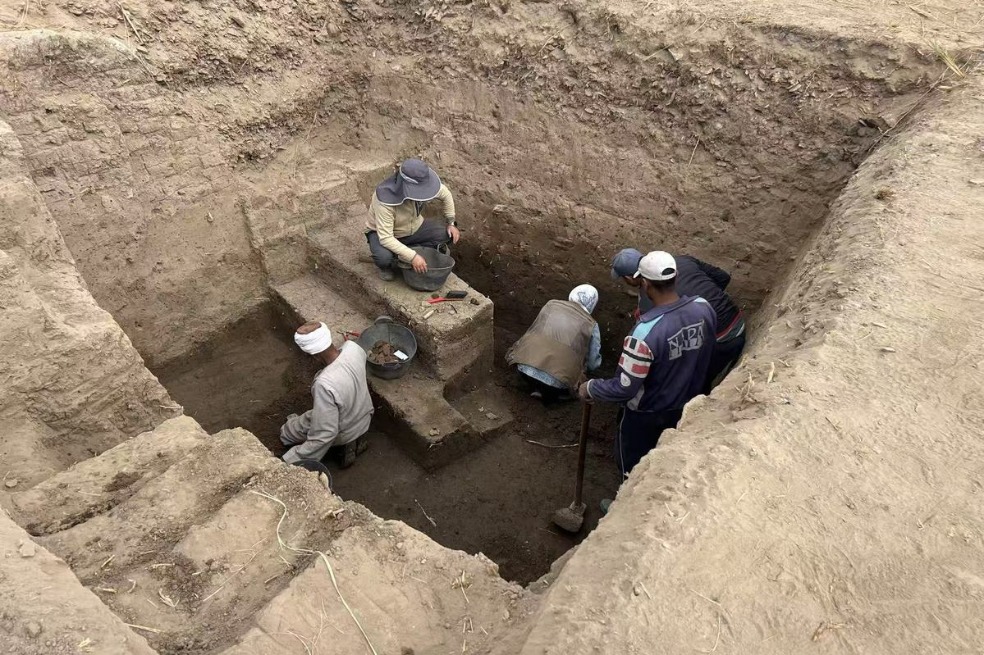
At the Suyab archaeological site, which is identified as present-day Ak-Beshim in Kyrgyzstan, the two sides have jointly assessed its historical value, preservation status, materials, and deterioration, providing a scientific basis for future conservation work.
They also upgraded a joint laboratory platform in Bishkek this year, enabling rapid diagnosis and mapping, physical property analysis, material testing, and remote monitoring, so that many basic tests and routine assessments can now be carried out locally.
The cooperation is thus evolving from individual projects into a longer-term mechanism involving joint research, expert exchanges, field investigations, and professional training.
For Samidin Bakirdinov, a graduate of Kyrgyz National University, one of the key takeaways from the program was seeing how China uses technologies such as 3D modeling and digital archives as part of a systematic approach to heritage conservation.
"I intend to put the knowledge I've gained into practice in preserving our own cultural heritage," Bakirdinov says, adding that cooperation between the two countries is "promising and beneficial". He hopes to adapt what he has learned to Kyrgyzstan's own conditions, laws and traditions "so that the voice of the past may resound in the future".

Looking ahead, he hopes the partnership will lead to more joint conservation projects, a shared digital platform, and greater exchanges and internships for heritage professionals.
For the Dunhuang Academy, such cooperation reflects a responsibility that extends beyond the preservation of China's own heritage, as it firmly holds that protecting and passing on historical and cultural heritage is a responsibility to history and to the people.
That responsibility is taking practical shape through cooperation along the Silk Road.
"Cultural heritage conservation is a long-term undertaking, and talent is the foundation for sustainable conservation," Zhang says. Through joint research, training and fieldwork, the China-Kyrgyzstan partnership is laying the groundwork for heritage to be protected not only today, but also by the people who will safeguard it tomorrow.

Related Stories
- Honghe showcases agricultural, cultural treasures
- European vintage car enthusiasts retrace the Silk Road on 50-Day odyssey across China
- Sound of Harvest 2026: Tracing a musical journey from Dunhuang to modern times
- Ancient wooden arch bridges get a new lease of life in Fujian
- Tourism a uniting force for Kyrgyzstan, China






Editor's Pick










