


3 foreign satellites among 9 launched by Kinetica 1
By ZHAO LEI | China Daily | Updated: 2025-12-11 09:26


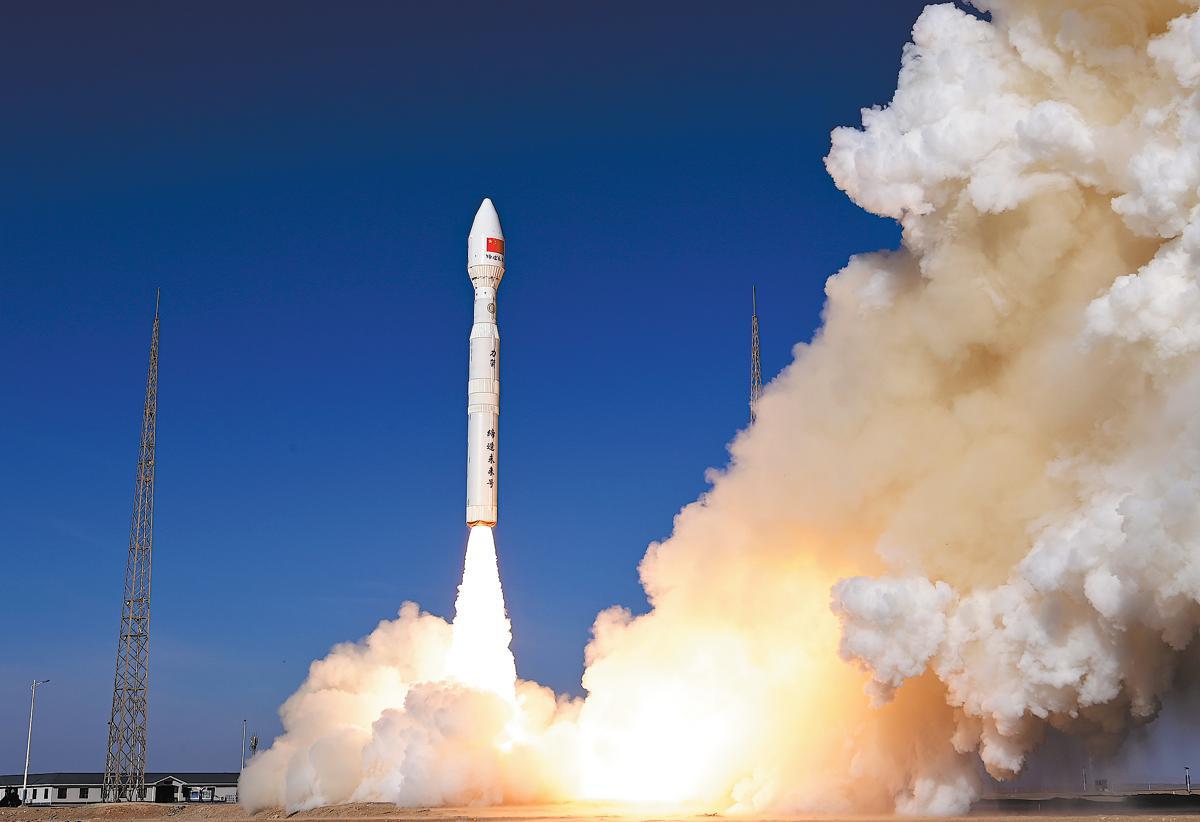
CAS Space, a leading commercial rocket maker, launched the 11th Kinetica 1 carrier rocket on Wednesday afternoon, deploying nine satellites, including three for the United Arab Emirates, Egypt and Nepal.
The rocket lifted off at 12:03 pm from the Jiuquan Satellite Launch Center in the Gobi Desert of northwestern China and successfully placed the payloads into their preset orbits, the company said in a statement. The satellites included six Chinese multifunctional satellites, an Earth-observation satellite for the UAE, a scientific satellite for Egypt and an educational satellite for Nepal.
The UAE satellite, called 813, was developed by the Innovation Academy for Microsatellites, a Shanghai-based subsidiary of the Chinese Academy of Sciences, for the National Space Science and Technology Center at United Arab Emirates University.
It carries a hyperspectral imager, a panchromatic imager and an atmospheric polarimeter to collect data for precise monitoring of vegetation, water bodies and land use, as well as detailed mapping, surface feature detection, environmental surveys and climate change research.
According to media reports in the UAE, engineers from 12 Arab countries, including Saudi Arabia, Kuwait, Jordan and Bahrain, took part in the research and development effort, which has been described as the Arab world's first joint satellite project.
The Egyptian satellite, SPNEX, or the Space Plasma Nano-satellite Experiment, is a mini satellite jointly developed by the Egyptian Space Agency and Egypt's Academy of Scientific Research and Technology. It focuses on measuring and characterizing space plasma in the ionosphere to support climate change studies.
The Nepalese satellite, Slippers2Sat, was built by a group of middle school students in Nepal with support from the Nepalese nonprofit organization Antarikchya Pratisthan Nepal and the United States-based Amateur Radio Digital Communications. It will be used for technology demonstration.
"After the satellites start formal operations, they will provide technical services and data support for Egypt, Nepal and the UAE in areas such as emergency response, earthquake precursor monitoring and environmental monitoring," said Hu Xiaowei, project manager of the Kinetica 1 series. "They will help these countries improve the operational efficiency of public infrastructure and make better use of space-based information."
The Kinetica 1 rocket is 30 meters long, has a diameter of 2.65 m and a liftoff weight of 135 metric tons. It can deploy satellites with a combined weight of up to 1.5 tons to a typical sun-synchronous orbit about 500 kilometers above Earth.
CAS Space has so far used Kinetica 1 rockets to deploy 84 satellites with a combined weight of 11 tons, making it the top company by business share in China's commercial launch market.
Wednesday's mission marked the fourth time Kinetica 1 has carried satellites for foreign clients.
During its fifth flight in November 2024, the rocket placed 15 satellites into orbit, including IRSS-1, which was designed and built by the China Academy of Space Technology for the Omani space startup Oman Lens. That mission marked the first time a Chinese commercial space company launched a satellite for a foreign client and the first successful orbital launch of an Omani satellite.
During Kinetica 1's eighth flight in August, two Mexican mini satellites were deployed into orbit. In October, the ninth Kinetica 1 mission placed HS-1, Pakistan's first hyperspectral imaging satellite, into orbit.
Shi Xiaoning, Kinetica 1's chief designer, said on Wednesday that the company plans to make the rocket reusable by adding parachutes and grid fins.
zhaolei@chinadaily.com.cn




Editor's Pick










