


Bailu Bay turns eco-revival into rural prosperity
Environmental restoration and art-driven tourism have transformed a former wasteland in eastern China, attracting an increasing number of both wildlife and tourists, Zhao Ruixue reports from Rizhao, Shandong.
By ZHAO RUIXUE | China Daily | Updated: 2025-12-20 11:07


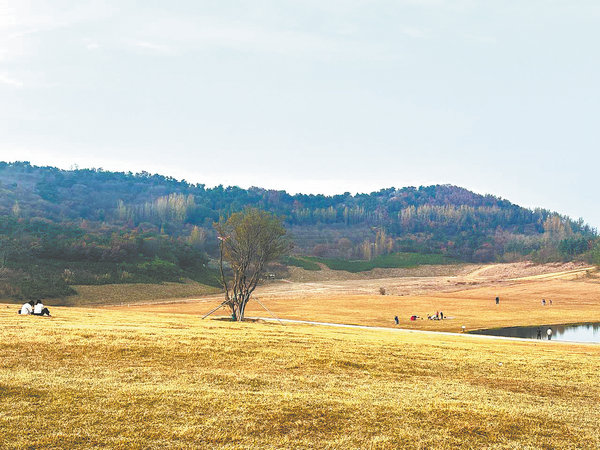
In early winter, Bailu Bay in Wulian county, Rizhao, Shandong province, exudes a serene beauty. Egrets stretch their wings, skimming over the mirror-like water, while nearby, a dozen swans glide gracefully, leaving gentle ripples in their wake.
"See that leading swan? It has a faint gray patch on its neck. It has returned here for the fifth consecutive winter," says Liu Ming, a staff member involved in the cultural and tourism project Bailu Bay Town.
"More birds are choosing to stop over at Bailu Bay, indicating that the ecosystem here is good."
An Ran, another staff member, recalls that back in 2012, this area was a completely different scene. "Where we stand now was desolate, with barren hills and sparse vegetation."
Today, it has transformed into a model for rural vitalization, integrating ecological parks, artistic landmarks and agricultural tourism.
Faced with the challenge of 80 percent bare land, the town embarked on a massive greening effort, planting hundreds of thousands of seedlings over the past decade, including cedar and red maple. This effort has boosted forest coverage to the current 70 percent.
"The saplings we planted were only as thick as a finger, but now they stand tall and lush," says An.
Restoring the water ecosystem was equally crucial.
Related Stories





Editor's Pick










