


Spring Festival celebrations to amplify consumption
Extended break this year seen reshaping travel and spending plans, unlocking consumer potential, particularly in services, travel and experience-driven expenditure
By Li Jing | China Daily | Updated: 2026-01-26 07:11


On Beijing's Wangfujing pedestrian street, winter temperatures have done little to slow foot traffic. Flagship stores are drawing a steady stream of overseas visitors, many taking advantage of expanded visa-free access and increasingly seamless digital payment options.
Daniel Chan, a tourist from Los Angeles, stepped out of an electronics store with a newly purchased DJI Osmo Nano camera.
"I've wanted this model for months. It's almost impossible to find stock back home, yet here it was available, and the price was very friendly,"Chan said. "It's not just a souvenir — it's cutting-edge technology."
He said he had already started using the camera on the day of purchase. "I haven't explored all its functions yet, but the magnetic design and image quality are quite good," he added.
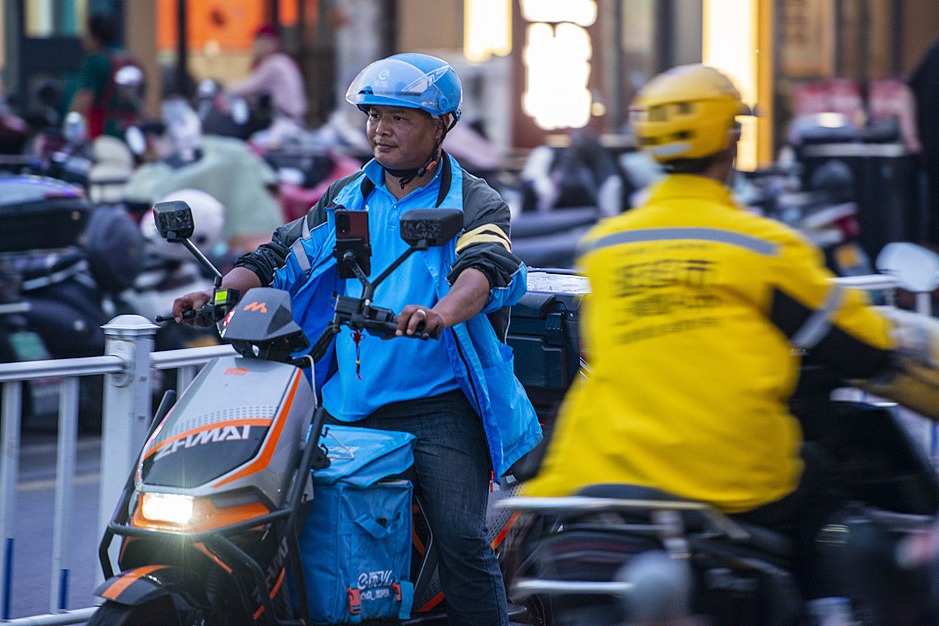
What impressed him most during his China trip, Chan said, was the speed and convenience of food delivery services. "It's incredibly fast and efficient — almost unbelievable," he said. Dining in restaurants was equally striking, with some offering dish countdown timers and guaranteed serving speeds. "I've hardly ever experienced service like this in the United States."
Such experiences are precisely what policymakers hope to encourage.
The "Shopping in China" campaign, first launched in April 2025, aims to create a more internationally friendly consumption ecosystem while stimulating domestic demand through higher-quality supply.
At the launch of the 2026 "Shopping in China" and New Year Consumption Season in Shanghai on Jan 3, Commerce Minister Wang Wentao said the initiative would focus on goods consumption, services consumption and the development of new consumption scenarios. A series of nationwide events, including a premium consumption month and an international consumption season, will be rolled out, alongside locally tailored programs in 15 pilot cities.
With the nine-day Spring Festival approaching, Wang said the Ministry of Commerce, together with other central departments and local governments, will host a "happy shopping for the Spring Festival" campaign as a flagship component of the "Shopping in China" series. The campaign will span food, accommodation, transport, travel, shopping and entertainment, aiming to create an inclusive, festive consumption experience for families at home and travelers on the move.
More than 1,200 kilometers south of Beijing, Yiwu — the world's largest small-commodities hub — offers a ground-level view of how festive demand is being converted into real orders.
In the plush toy section of Yiwu International Trade Market, one horse-themed product has become an unexpected viral hit. Originally launched in mid-October under the name "Mashang Youqian", meaning "immediate prosperity", the toy initially sold about 400 units a day — steady but far from a bestseller.
Its breakout moment came in January, after a minor production-line error resulted in the toy's mouth being stitched incorrectly, giving it a seemingly "tearful" expression. Buyers who received the flawed version posted photos and chat records online while requesting exchanges. The images struck a chord with netizens, who found humor and resonance in the toy's "wronged" look, quickly propelling it to the top of social media trending lists.
Dubbed the "crying horse", the toy was soon labeled the first cultural "dark horse" of the New Year. As demand surged, the factory expanded production lines from two to more than a dozen, lifting daily output to around 15,000 units. The merchant has since applied for a design patent.
Behind the viral moment, the success mirrors quality and Yiwu merchants' deeply ingrained ability to respond quickly to market signals, from identifying trends to making swift decisions and scaling production with minimal delay.
Across the toy sector, creative interpretations of the Year of the Horse are proliferating. Products range from zodiac photo frames to blind boxes and decorative figurines.
Some bestselling items now sell between 40,000 and 60,000 units a day. For popular designs, factories are producing between 50,000 and 100,000 units daily. To maintain speed and creativity, some merchants require their design teams to develop as many as five new styles each day.
Merchants say interest from foreign buyers has risen, particularly after Spring Festival was added to UNESCO's Representative List of the Intangible Cultural Heritage of Humanity in December 2024.
Consumption momentum is also visible in the catering sector, where Chinese New Year's Eve reunion dinners — a core element of Spring Festival culture — are being booked out well in advance.
In Beijing, several restaurant chains report that all private rooms across multiple branches are already fully booked, with only limited lunchtime slots remaining. Prices largely match regular menus, though advance reservations and deposits are typically required.
To cope with demand, many restaurants have introduced staggered dining slots on Chinese New Year's Eve, offering discounts for later sittings. Others have expanded takeaway services, allowing families to enjoy freshly prepared reunion meals at home.
One restaurant in Beijing's Guomao area has launched two takeaway packages priced at 1,988 yuan ($286) for eight to 10 people and 999 yuan for four to six people, with free delivery within the city's Fifth Ring Road. Customers can also order a la carte, providing greater flexibility.
An emerging trend is the shift toward county towns and rural venues. In Yinjiang town of Ningbo, Zhejiang province, a countryside resort that opened reservations three months ago, has already sold out large private rooms for the first two days of the holiday, attracting families traveling from neighboring Shanghai, and Jiangsu province.
Traditional restaurant brands are also moving into rural markets. Managers say demand for reunion dinners and banquets in these areas remains strong, while the supply of mid — to high-end dining options is relatively limited — creating new opportunities for expansion.
The nine-day break is also reshaping travel patterns, triggering a surge in both outbound and inbound tourism.
Major travel platforms report that Spring Festival bookings for 2026 have surpassed last year's levels across the board. According to data from Flight Master, as of Jan 16, bookings for domestic flights during the holiday exceeded 4.13 million, up about 21 percent year-on-year. Outbound and inbound flight bookings both climbed to around 700,000.
Airbnb data show searches by Chinese travelers for overseas accommodation around the Spring Festival period have roughly doubled year-on-year. Many travelers are choosing to stagger trips before or after the official holiday to secure better prices and less crowded itineraries.
Travel agencies are embedding New Year elements into overseas tour products, allowing travelers to retain a sense of festivity even while abroad.
Li Mengran, marketing manager of Beijing-based travel agency Utour, said the company has continued its long-standing practices in European tour products. These include customized reunion dinners and dumpling-making activities, alongside wine tastings and interactive prize draws.
"For family travelers, we also prepare red-envelope gifts for children under 16 to enhance the sense of ritual and warmth during the journey,"Li said.
Domestically, culturally rich "intangible heritage towns" are emerging as popular destinations. Data from Qunar show that cities such as Huangshan in Anhui, Jingdezhen in Jiangxi, Quanzhou in Fujian, Foshan in Guangdong and Zigong in Sichuan — all offering immersive intangible cultural heritage experiences — have seen particularly strong hotel booking growth during the winter holiday and Spring Festival period.
Inbound tourism is also gaining momentum.
Qunar data show that bookings for domestic flights made using non-Chinese passports during the Spring Festival holiday are up more than 20 percent year-on-year, underscoring the holiday's growing role as a window for international visitors to experience Chinese culture.
This rebound reflects sustained policy support. By the first three quarters of 2025, visa-free inbound visits reached 20.89 million, up more than 50 percent year-on-year. Since the introduction of the 240-hour transit visa-free policy, inbound arrivals across ports have risen 27.2 percent.
The World Travel & Tourism Council forecasts that China's tourism sector will grow at an average annual rate of 7 percent over the next decade, with the country on track to become the world's largest tourism market by 2031, surpassing the United States.







Editor's Pick










