


Attraction to DIY handicrafts beads to the urban surface
By ZHENG YIRAN in Shanghai | China Daily | Updated: 2026-05-22 06:50


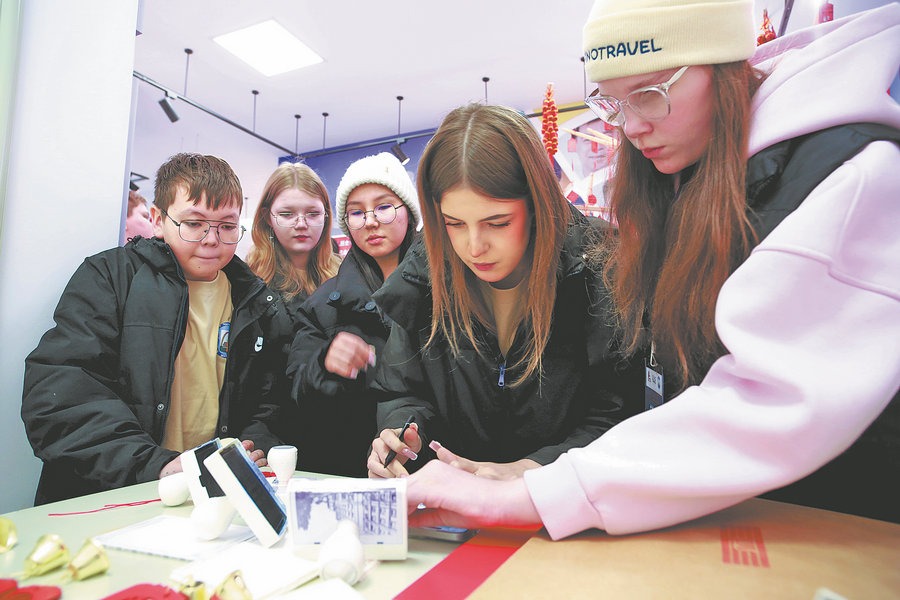
On a weekday night at a DIY store on Nanjing East Road, William Brook, an 11-year-old visitor from the United Kingdom in Shanghai, finally finished his peach blossom tree fuse-bead handicraft.
He worked on his "masterpiece" over two days. With the last pink bead pressed on the 50 by 50 centimeter plastic baseplate, the vivid peach blossom tree artwork was completed.
"I came to China for a piano competition. Yesterday, my mother and I were walking past this hobby store. I was fascinated by the fuse-bead handicraft. I love Chinese culture, so I decided to make a peach blossom tree as a special gift to take home," William says.
His mom also made over 100 heart-shaped fuse-bead handicrafts at "San Qian Zao Wu She", or 3000 DIY Store, as gifts for relatives and friends. She feels the handmade craft symbolizes sincerity.
Fuse bead art, also known overseas as Perler beads, is a handicraft that involves arranging small plastic beads into patterns and fusing them with heat. It is usually marketed as a toy for children, but is now widely practiced by adults as a stress-relieving hobby.
Wu Yuyan, a customer working in advertising, says she was bombarded with work-related text messages day and night, which exhausted her. "When I put my phone away and focused on making fuse-bead art, I could feel relaxed joy.
"I love the concentration and serenity," the 32-year-old says.
"Modern people are usually under great stress. It's hard to concentrate. The charm of fuse beads helps people concentrate and relax. When they are immersed in handicrafts, they don't think about anything else," says Qian Mengyao, a young shop assistant born after 2000.
"In addition, they can use fuse beads to make patterns they like, such as idols or cartoons, which demonstrate their creativity," she says.
Fuse bead art can be traced back to the 1970s, when it was not originally intended for personal enjoyment, but for rehabilitation training in nursing homes. In the 1980s, Perler, in the United States, improved it into a children's puzzle toy, which later spread worldwide.
At the end of 2024, a young Chinese actor showcased a homemade fuse-bead brooch during a live promotional broadcast, thus igniting the "fuse bead craze" in China.

Subsequently, with the continued support of numerous popular IPs, the trend grew stronger: in Taobao's "top 10 products of 2025", fuse bead art ranked second, with year-on-year search volume increasing by nearly 500 percent. The hashtag "I'm addicted to fuse beads" on the social media platform Xiaohongshu exceeded 6.9 billion views. The 2026 Spring Festival consumption data of Douyin, China's TikTok, show that the number of orders placed by Generation Z (those born between 1995 and 2009) for group purchases of beads is up by 9,018 percent year-on-year, much higher than the 348 percent growth rate of the second-rated group buy, pet foster care.
In Luer King, a handicrafts store on Daxue Road in Shanghai, customers stay for the whole afternoon or even till evening working on their handicrafts, and there are consistently team-building activities with over 20 people in the store.
Lin Xianping, associate professor of Hangzhou City University, says: "Fuse beads' rapid popularity lies in its precise alignment with the consumption and emotional needs of young people today. Its creation threshold is low and does not require professional skills. The time-consuming and focused assembly process allows young people to break away from electronic devices, achieve emotional and stress relief, and after completing exclusive works, they can also gain a strong sense of achievement."
As promising as the market is, Lin says that in the long run, the "handmade economy" needs to continuously innovate gameplay, create differentiated content, and deepen IP integration to overcome the limitations of trends. Overall, if the demand for emotional consumption remains unchanged, the "handmade economy" has long-term growth potential and is on a high-quality track for consumption upgrading, according to Lin.
Related Stories







Editor's Pick










