


Mount Olympus, D-Day landing sites make UNESCO list
By JONATHAN POWELL in London | China Daily | Updated: 2026-07-28 07:16


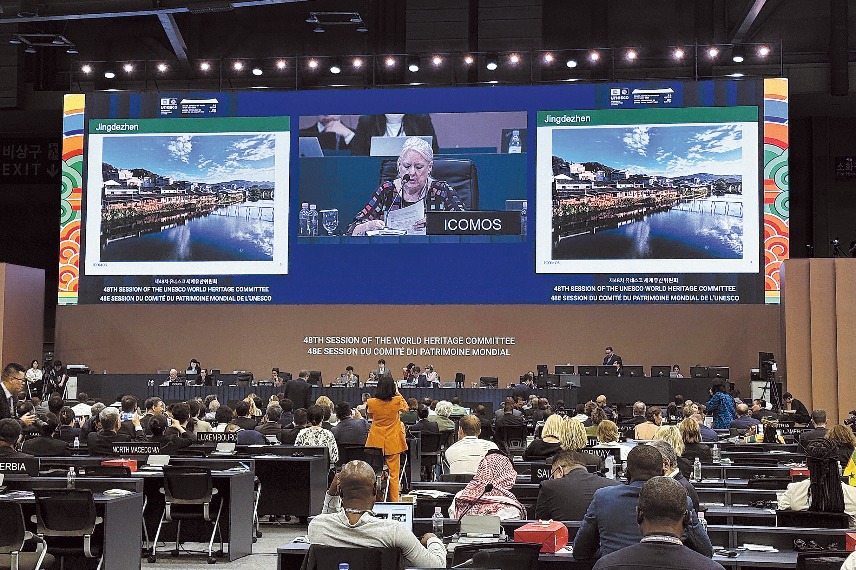
Mount Olympus — the mythical home of the ancient Greek gods — was added to UNESCO's World Heritage List on Sunday at a committee meeting in Busan, South Korea.
Among other sites inscribed were China's Jingdezhen handicraft porcelain industry sites, and South Sudan's Boma-Badingilo Migratory Landscape, home to one of the world's largest land mammal migrations and the country's first World Heritage listing.
UNESCO recognized Olympus as a mixed cultural and natural site, capping a 12-year Greek bid to secure the designation.
Rising to 2,918 meters from near sea level, the mountain is venerated as the mythological throne of Zeus, the king of the Greek gods, and is noted today for its rich biodiversity.
Greece's delegate to UNESCO, Georgios Koumoutsakos, said: "We reaffirm our unwavering commitment to safeguarding Mount Olympus for the benefit of present and future generations. As Greek mythology wisely reminds us, it is always best to remain on good terms with gods."
Evangelos Geroliolios, mayor of Dion-Olympus, a municipality at the foot of the mountain, told The Associated Press that inclusion on the list "places greater obligations on our part to protect this environment", pointing to the potential impact of increased tourism.
The inscription of Jingdezhen, China's "porcelain capital" where kiln fires have blazed for more than 2,000 years, brought the total number of World Heritage sites in China to 61.
It marks the first time that China has nominated an industrial heritage site for World Heritage status, and it is also the first World Heritage site themed around porcelain.
The World War II D-Day landing sites in northern France have also been added to the list, with France's inscription covering the five Normandy beaches — Omaha, Utah, Sword, Gold and Juno — and the Pointe du Hoc assault site.
These places, where more than 150,000 Allied troops came ashore on June 6, 1944, are recognized as central to the campaign to liberate Western Europe from Nazi occupation.
After the listing of the 80-kilometer stretch of Normandy coastline, France's permanent delegate to UNESCO, Ahlem Gharbi, said the designation carries particular weight amid today's international tensions.
Herve Morin, president of the Normandy region and a leading advocate of the bid that was first submitted in 2008, said inclusion represents "immense recognition" for the soldiers who sacrificed to defeat Nazism.
South Sudan's Boma-Badingilo Migratory Landscape spans wetlands, flood plains and savannas, hosting a vast antelope migration, and provides a habitat for elephants, lions and cheetahs while sustaining farming and fishing communities, UNESCO said.
The UNESCO committee is meeting in Busan through to Wednesday this week to review about 30 nominations, with successful bids to join the 1,248 sites across 170 countries already on the World Heritage List for their "outstanding value to humanity".







Editor's Pick










