


High technology driving parcel industry efficiency
By LUO WANGSHU in Guangzhou | China Daily | Updated: 2026-08-13 09:16


China's parcel industry is accelerating the use of artificial intelligence, robotics and other technologies to improve efficiency, as automation expands from sorting lines to warehousing, internal transport and other parts of the logistics chain.
A major China Post processing hub in Guangzhou offers a glimpse of that shift. Much of the sorting and internal movement of parcels has already been automated, while humanoid robots are being tested for some of the remaining labor-intensive tasks.
At the Guangzhou postal processing center, workers still play a major role in tasks such as loading and unloading trucks, while most sorting and internal parcel movement is automated, according to Li Shan, manager of the center's operations and maintenance unit.
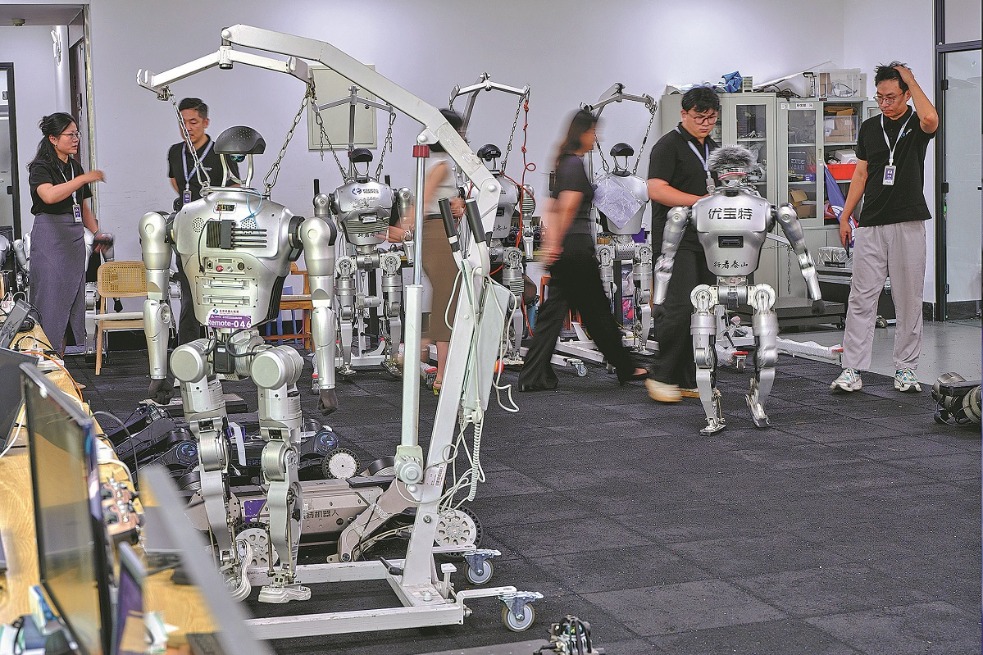
At its Jianggao site, eight humanoid robots have been tested on a small parcel feeding line since March, with another five planned. The robots currently sustain a feeding rate of about 800 parcels an hour and have reached a peak of 1,200 after repeated training and adjustments.
Human workers can typically handle about 1,600 to 1,800 parcels an hour. The center aims to raise the robots' rate to around 1,600 by the second quarter of 2027, bringing them close to human productivity.
The trials add a new type of machine to an operation where more conventional forms of automation are already widely used.
Eight robotic arms feed parcels suited to automated handling onto sorting lines, processing about 1,070 items an hour under normal conditions and up to 1,400 at peak. Fourteen automated guided forklifts move cages and pallets around the facility, serving 31 pickup and delivery points and making an average of 178 trips a day.
Workers step in when machines encounter soft bags, irregular packages or other items that are difficult to handle. "We never blindly pursue full automation in one step," said He Yong, deputy director of the Jianggao mail processing center. "What matters is human-machine collaboration that fits actual operations."
Automation is also extending beyond individual pieces of equipment. At the Guangzhou center's Airport North site, a digital system monitors pressure across sorting lines, automatically adjusts operating speeds and issues alerts when problems occur.
Since its introduction, sorting line jams during night shifts have fallen from more than 20 a month to about one, according to the center.
Similar efforts are taking place in warehousing, where companies are developing systems to reduce repetitive manual work and make better use of limited space.
Genye Technology, a Guangzhou-based company specializing in smart warehousing systems, has developed a three-dimensional sorting system designed to reduce the amount of walking and manual handling involved in picking and sorting goods.
Zuo Wen, general manager of the company's innovation business center, said the idea grew partly out of what he saw during a visit to an overseas customer's warehouse.
"Workers were pushing carts from shelf to shelf, holding order sheets and looking for the goods they needed before taking them to the designated area," Zuo said. "It was even more manual than what we commonly see in China, where simple roller conveyors or belts are already widely used."
The experience prompted the company to look for ways to reduce the distance workers needed to travel inside warehouses. Its system uses AI vision and scheduling software to direct goods to vertically arranged sorting positions, allowing more of the movement and sorting process to be automated.
Zuo said the wider adoption of automation has changed parcel processing in China considerably over the past decade.
"Back around 2015 and 2016, parcel backlogs were common during peak periods. Even with people working around the clock, there could still be more parcels than they were able to handle," he said. "You rarely see that kind of large-scale backlog in China today, and automation has played an important role in improving sorting efficiency."
The developments in Guangzhou reflect a broader transformation in China's parcel industry.
Earlier rounds of automation largely centered on conveyors, sorting machines and other equipment designed for specific tasks. More recent efforts are combining automated equipment with software, data and newer forms of robotics across warehousing, sorting and transport.
China's postal sector development plan for the 15th Five-Year Plan period (2026-30) calls for deeper integration of AI into areas including warehousing, transportation, collection and delivery, as well as wider upgrading of sorting and other processing equipment. It sets a target of 88 percent for the full automation rate at major processing centers by 2030, according to the State Post Bureau of China.
luowangshu@chinadaily.com.cn





Editor's Pick










