


AI can restore confidence, unlock growth
By Alessandro Golombiewski Teixeira | China Daily | Updated: 2026-08-26 09:56


The International Monetary Fund in July projected 4.6 percent growth for the Chinese economy in 2026, one of the strongest results among major economies.
China's economy has also demonstrated considerable resilience in the first half of the year, with GDP expanding 4.7 percent year-on-year despite a challenging global environment.
Yet some Western economists remain skeptical of China's growth path, citing structural concerns including an overreliance on trade rather than domestic demand and adjustments in sectors such as steel, electric vehicles and solar panels.
But what both official and independent readings agree on is that households, enterprises and local governments have all become more measured about spending, investing and borrowing. One possible key lever to spur growth is boosting the willingness of households, businesses and local governments to spend, invest and borrow again. And a new cluster of technologies — smart manufacturing, space technology, the low-altitude economy, robotics, big data and, above all, artificial intelligence — is helping to build that confidence and create new opportunities for growth.
A global comparison helps explain why these technologies, AI especially, carry this weight. Global capital is increasingly recognizing the transformative potential of AI and related technologies. The point is not which company is "better", but what the gap reveals: Global capital now assigns trillion-dollar valuations almost overnight to companies considered to be at the frontier of AI, in a way it never did for the previous tech cycle's retail and software platforms.
China's growth model has long rested on three engines: exports (about 20 percent of GDP in 2024), household consumption (around 39.9 percent), and gross capital formation — the broad measure covering investment and infrastructure — at roughly 40.6 percent.
These figures capture the distinctive structure described above: Investment remains unusually high by international standards, consumption comparatively low. Exports still perform well, aided by industrial scale and diversification toward Europe and Latin America that has offset the weaker demand of the United States, but investment-led growth is harder to sustain as infrastructure can no longer serve as an unlimited stabilization tool.
Greater confidence should be built in consumption. Retail sales rose 3.7 percent in 2025, online retail increased 8.6 percent, and final consumption contributed 52 percent of GDP growth — five points more than the year before. That is a meaningful shift, but not yet a full substitute for property-led growth.
History offers a guide. Japan after 1990 showed that even near-zero rates cannot force households focused on repairing balance sheets to spend. China's own reform era is more encouraging: Deng Xiaoping's 1992 Southern Tour shifted expectations so decisively that real fixed investment rose 28.2 percent that year. Confidence returns when policy signals are sustained. China's own experience demonstrates how stronger expectations can unlock investment, entrepreneurship and economic activity.
This is where AI — and the wider array of frontier technologies now emerging in China — becomes economically relevant, not as a symbol but as a potential fourth engine reinforcing the other three.
In exports, it can lift manufacturing productivity and push companies into higher-value segments, as Chinese labs such as DeepSeek have shown they can already do on the global stage. China's world-class manufacturing base gives it a strong platform for turning AI advances into productivity gains across the real economy.
In investment, it can redirect capital from basic infrastructure toward computing power and data centers — the very assets global markets now reward with premium valuations.
In consumption, it can open up demand in healthcare, education and digital services, while creating new products, services and employment opportunities for households.
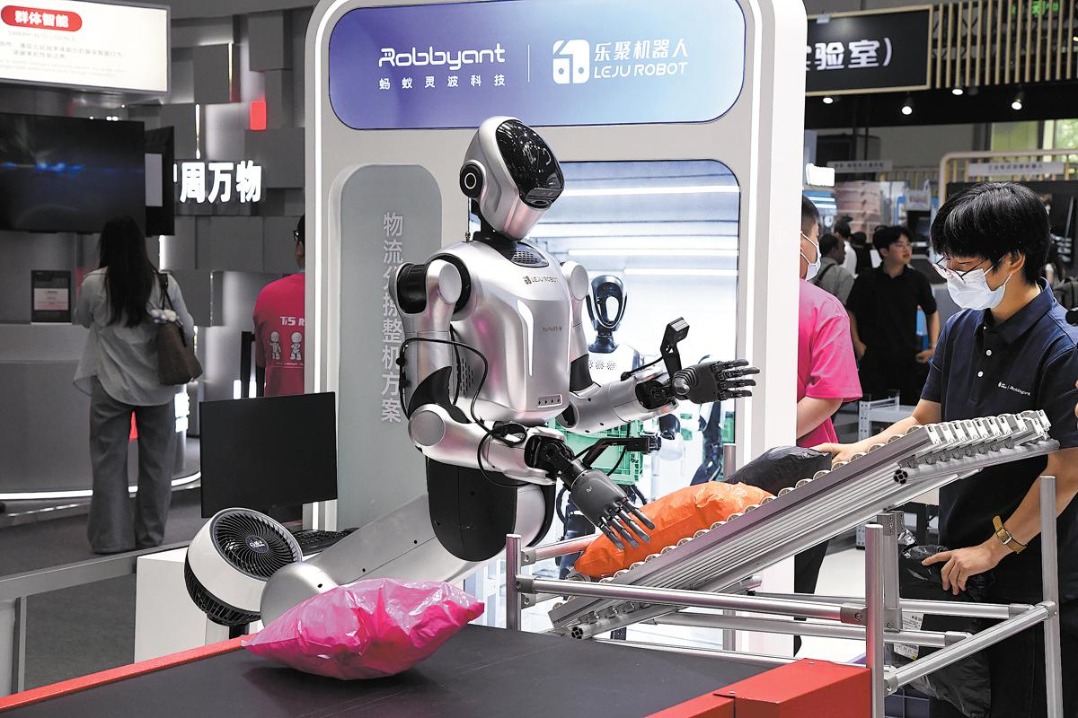
The scale on display at the 2026 World AI Conference and High-Level Meeting on Global AI Governance, backed by evident State commitment, signals this is a growth strategy, not a side project. Technology alone cannot inject confidence in all sectors. Turning that into domestic confidence still requires more active policy support — so that AI-driven growth becomes secure jobs and rising incomes, and eventually stronger household confidence and consumption.
China's transition can be summarized simply: In the earlier growth phase, expansion generated confidence; in the phase ahead, confidence will have to generate expansion. An economy with real capacity and increasingly sophisticated sources of innovation and growth, is still working to fully unlock the confidence needed to put that capacity to work. AI, if it can convert conference-hall momentum into household-level trust, may be the engine that helps supply it.
The author is a former tourism minister of Brazil, a distinguished professor at Tsinghua University and a professor at The Chinese University of Hong Kong in Shenzhen.
The views do not necessarily reflect those of China Daily.
If you have a specific expertise, or would like to share your thought about our stories, then send us your writings at opinion@chinadaily.com.cn, and comment@chinadaily.com.cn.






Editor's Pick










