The sailors who disappeared
Seminar highlights contribution of UK's forgotten Chinese World War II mariners
By XING YI in Liverpool, England | chinadaily.com.cn | Updated: 2026-11-20 06:55


At Liverpool's Pier Head, a memorial plaque bears a gilded inscription in English and Chinese on polished black marble that recalls a heroic story shadowed by shame.
It reads: "To the Chinese merchant seamen who served the country well during both World Wars. For those who gave their lives for the country – Thank you."
It goes on to say: "To the many Chinese merchant seamen who, after both World Wars, were required to leave. For their wives and partners who were left in ignorance of what happened to their men. For the children who never knew their fathers. This is a small reminder of what took place. We hope nothing like it will ever happen again."
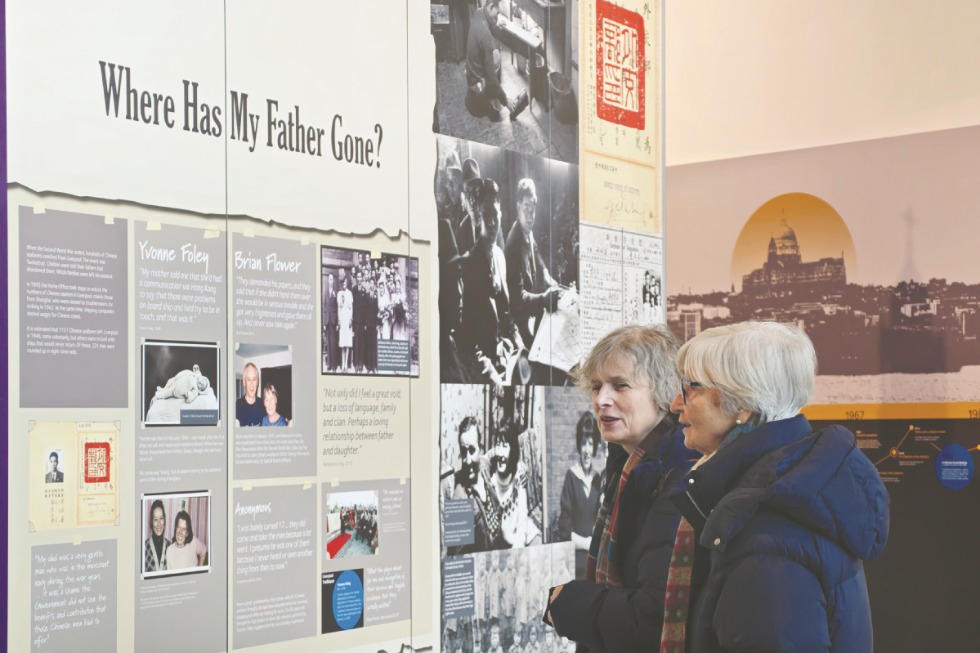
The story of the men and their fates was the subject of a recent seminar in the northwestern English city that was attended by researchers, campaigners, and some descendants of the Chinese seamen. It was an event that sought to shed light on this long-forgotten and, in some ways, inconvenient chapter of history.
The first Chinese people to arrive in Liverpool in the 1860s were mainly seamen, the result of the expansion of maritime trade between Asia and Europe.
Working on ships sailing between the port city of Liverpool and hubs in China and Southeast Asia, they established the oldest Chinese community in Europe.
During both world wars, Chinese seafarers contributed to the allied war effort and made significant sacrifices. During World War II, around 20,000 Chinese seamen, roughly one in 10 of the Merchant Navy's crews, worked on ships in the Atlantic convoys, transporting vital supplies between North America and the UK.
"There were ordinary people from worker or peasant backgrounds, and there were skilled workers too, engineers, fitters, joiners, and there were also the more educated," Jenny Clegg, an independent researcher on China, said at the seminar on Nov 14.
"The Chinese seamen crewed the dangerous Atlantic run, bringing vital food and munitions to support the war effort, and transported troops and supplies to the campaigns in North Africa and beyond," Clegg said.
Shortly after the war, the Liverpool Daily Post reported that the Chinese men were a "gallant body of men whose service to the Allied cause, through the Merchant Service, is greatly appreciated".
The contribution of Chinese merchant seamen was also featured in a wartime documentary, The Chinese in Wartime Britain, which was broadcast by the BBC in 1944.
"Thousands of Chinese seamen now serving the allied Merchant Navy, bringing food to Britain, munitions from America, cargos from Africa and the East," the program said, showing footage of Chinese seamen loading goods, working in engine rooms, and manning guns aboard ships.
It continued: "China fights not only on land in the East, engaging huge Japanese forces, but in the West, her men fight on the Merchant Navy front, shoulder to shoulder in the greatest battle of naval history, alongside their British seamen comrades. They too brave the torpedoes, bombs, and mines, making history under fire."
One Chinese merchant seaman, Poon Lim, even gained fame after surviving 133 days on a raft when a German submarine torpedoed his British ship. The documentary praised Lim and his compatriots as close allies, declaring that "East met West, and liked it".
However, according to researchers, Chinese seamen were not treated equally next to their British counterparts. They were paid lower wages and received no overtime pay or war bonuses.
To fight for their rights, a branch of the Chinese Seamen's Union was established in Liverpool. With membership peaking at 10,000, the union campaigned for equal pay and war-risk bonuses and eventually secured pay increases in 1942.
"In fighting against the racial injustice, the Chinese seamen were not alone," Clegg said, adding that many Britons, including her father, Arthur Clegg, helped raise the issue of unequal pay with the UK government.
Earlier this year, she donated a box of archives collected by her father from the Liverpool Chinese Seamen's Union. She hoped the items, which went to the Maritime Museum Archives, would enable more people to research the historic chapter.
But the end of the war brought an unexpected outcome to many of the Chinese sailors who remained in the UK after the fighting stopped.

Between 1945 and 1946, a secret operation was launched to forcibly deport around 2,000 Chinese seamen from Liverpool, despite many of them having British wives and families in the UK.
The operation was detailed in a document numbered HO 213/926 titled Compulsory repatriation of undesirable Chinese seamen. The document was declassified in the 1990s but was not widely known about until it was the subject of a story in The Guardian newspaper in 2021.
A Labour Party spokesperson was quoted by the newspaper as saying: "The Labour Party deeply regrets the policy of the 1945 British government that saw the repatriation of an unquantified number of Chinese seafarers who had supported the war effort and in doing so fathered children in the UK. The policy of repatriation caused lasting damage to families, and scars that have run deep through several generations."

Most researchers on the issue estimated around 200 wives lost their husbands without being told what had happened to them. Some women died without ever learning the truth, while others believed their husbands had abandoned them. Their children, many now in their 80s, grew up with unanswered questions about their fathers.
Joseph Phillips Sze is one of them.
The youngest of four children born to Chinese seaman Ah Lung Sze and his British wife, Helen Kassin, Joseph was born in 1947 and has never seen his father.

He once dropped his Chinese surname because he had been led to believe his father had deserted his mother and four children. But after learning that his father had been taken away, his anger turned to a longing for the truth.
"I'm not angry anymore; what I want now is truth," said Joseph, who has spent the past seven years tracing his father's history. He has also built a website, Injustices 1946, to explore the family history and the collective public memory.
In July 2024, Joseph, together with other descendants of the Chinese seamen and Liverpool City Councilor Steve Munby, unveiled a blue plaque at the site of a former Chinese boarding house at 10 Great George Square, near the city's Chinatown.
The plaque, with a design of a Chinese character for memory, reads: "In memory of the Chinese seamen who were forcibly deported from Liverpool in 1946. Wherever you are, you will be in our hearts."

Kim Johnson, the member of Parliament for Liverpool Riverside, has been a vocal campaigner for recognition of the Chinese seamen's experiences, and a formal government apology for their forced deportation.
"This is a campaign that will continue going forward," Johnson said at the Liverpool seminar, recalling how she became aware of the tragic story of the Chinese seamen and their families in 2004 and describing it as a "very black stain" on the local history.
"We just had Remembrance Day, and people know soldiers from the Commonwealth served and lost their lives, but often do not acknowledge the thousands of Chinese seamen who battled in the Atlantic, were paid less, and yet provided this country with the support that they needed at a very difficult time," she said.
Earlier in September, Johnson initiated a parliamentary motion calling on the government to issue a full and formal apology for the injustices. The motion was supported by 18 other members of Parliament.
"I think these stories need to be told ... and the wrong needs to be righted," she said.
Han Jing contributed to this story.

Photo







Editor's Pick