


Couple turns 100,000 Great Wall photographs into actionable protection
Xinhua | Updated: 2026-01-12 07:00


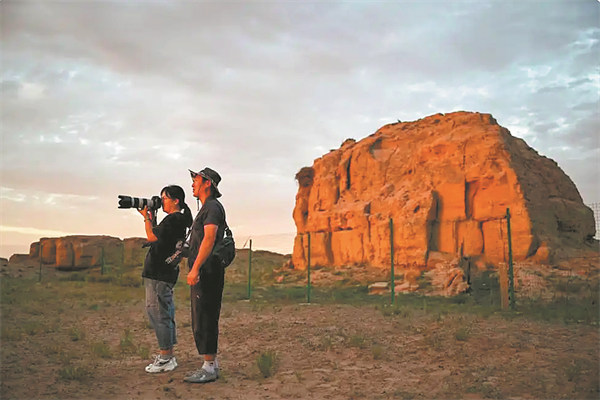
For most visitors, the Great Wall is an ancient structure they get to experience and walk along once in their lifetime. But one couple kept returning. After visiting the wall several times over a decade, Gao Wandong and Chen Jing had taken more than 100,000 photographs, and decided to house them in a museum of their own.
That museum sits in Changcheng Village, translated as the "Great Wall village", in Yanchi county of Northwest China's Ningxia Hui autonomous region, a quiet courtyard built with borrowed money and unrelenting conviction.
Inside are photographs taken at dawn and dusk, shards of porcelain pulled from sand, Ming Dynasty (1368-1644) bricks rescued from being reused as doorsteps, and shelves of local chronicles gathered one by one over years of travel.
The Great Wall stretches for 259 kilometers across desert plains and rolling hills in Yanchi. Along it lie the remnants of an old frontier: 23 ancient forts and 169 watchtowers and beacon platforms.
"The Great Wall was our childhood companion," Gao says. At 55, he still remembers using the tall beacon towers as shelter from sudden sandstorms while herding sheep. As a boy, he picked up arrowheads and shards of pottery without thinking much of them. Only years later did he realize those "lumps of earth," as he once called them, were disappearing, flattened by time, weather or reuse.
After they married, Gao, a civil servant, and Chen, a schoolteacher, began spending weekends driving deep into the countryside. Some sections of wall existed only as faint lines on old maps or as directions passed between villagers. Gao drove and kept notes while Chen took photos. At first, it was an unsystematic hobby that left them physically exhausted and logistically uncertain. But it held them.
Meandering over mountain ridges across North China, the Great Wall was built over more than 2,000 years. The sections of this world wonder that exist today have a total length of over 21,000 km.
Verification of the existing sections often meant long, punishing days. Gao and Chen drove more than 100 km to confirm the existence of a single beacon tower. Their cars became stuck in the sand, and food ran out. They left before sunrise and waited until the dusk for a chance to capture the wall as it truly was.
Chen's equipment evolved with her resolve. She borrowed a camera, then bought one. Later, she learned to fly drones, process images, and design layouts.
In 2014, the work took on new urgency. Yanchi county established a Great Wall protection association and launched a program allowing individuals to "adopt" specific sites. Gao and Chen contributed 5,000 yuan ($716) to help fund the restoration of a Ming-era beacon tower. They set themselves a goal: to systematically document every remaining stretch of the Wall in Yanchi within five or six years.
The result was published in 2019. Illustrated Yanchi Great Wall, with a selection of 600 images from more than 100,000 photographs, reads less like technical records than visual testimony: Watchtowers at dawn. Border walls at dusk. Life pressed quietly against stone.
"Standing beneath the ruins," Chen says,"I feel like I can talk to them."
But images, they soon realized, were not enough.
China's Ministry of Culture and Tourism has required 15 provinces and municipalities along the Great Wall to formulate specific plans for the construction of a national Great Wall culture park tailored to local conditions.
The Great Wall is gaining new life with new development opportunities.
To raise public awareness and preserve Great Wall culture, the couple spent more than 200,000 yuan rescuing Ming-era bricks and ancient construction tools from villagers who might otherwise reuse them. They also collected more than 2,000 local chronicles tracing the Wall's history across centuries. Gradually, the idea of a museum became inevitable.
Since opening in 2020, the museum has welcomed thousands of visitors each year, many of them researchers and dedicated Great Wall enthusiasts. The couple hosts photography exhibitions and educational programs, turning a private obsession into a shared intangible fortune.
Today, Gao serves as vice-president of the county's Great Wall protection association."In recent years, Yanchi has stepped up protection, and cases of deliberate damage have largely disappeared," he says.
"Before restoration techniques can be fully realized to repair the old as old, the best protection is to prevent damage," Chen says.
Related Stories




Editor's Pick










