


Public safety built into the social structure: China Daily editorial
chinadaily.com.cn | Updated: 2026-04-22 20:52


There is a certain smugness evident whenever some in the West discuss "the rule of law", as though the phrase alone was sufficient to guarantee order, fairness and personal safety. Yet the lived experience of safety tells a different story.
Even societies that pride themselves on legal sophistication often struggle to deliver basic public safety evenly. The wildfires in one developed country offered a revealing vignette: in the affluent neighborhood, private firefighting crews shielded commercial assets while nearby homes burned. It was a tableau that spoke less of natural disaster than of institutional asymmetry — protection as a purchasable good, rather than a legitimate right for all.
In recent months, a wave of foreign bloggers has inadvertently punctured the complacency behind the smugness by coining a phrase that now circulates with quiet insistence: "The Chinese way of safety".
It sounds faintly anthropological, but the examples are disarmingly mundane. Parcels left untouched at doorsteps. Solo diners lingering over late-night street skewers without apprehension. These are the texture of everyday life in a society where public safety has become so pervasive as to be almost invisible.
In China, public safety is not commodified but embedded within the architecture of the country. The expectation — widely shared and largely fulfilled — is that protection extends to all people.
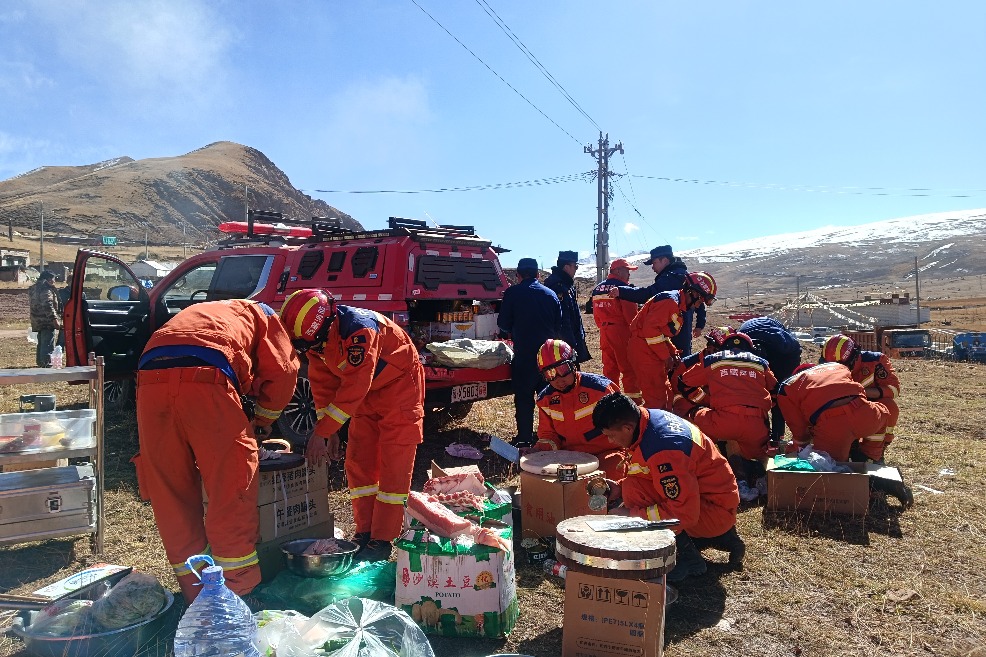
Dial an emergency number, and help arrives. That this holds true in megacities and remote counties reflects a system designed to prioritize people-first governance.
Laws on paper might be well-intentioned but they do not suffice on their own. What distinguishes China's model is the efficiency of its grassroots governance that translates laws into practice and results. This latticework of governance is reinforced by technology. Grid-based management systems, digitalized law enforcement platforms and high case-clearance rates contribute to a sense that rules are not merely proclaimed but enforced. The result is a feedback loop: low crime fosters trust, and trust, in turn, reduces incentives for crime.
Augmenting this is the emphasis on dispute resolution at the community level, with ubiquitous local mechanisms — from neighborhood committees to social and volunteer groups — that function as neighborhood stabilizers. Even the national government hotline "12345", which operates round the clock through the year, fields millions of citizen complaints and plays a quiet but crucial role: it reassures the public that grievances can be aired and addressed.
International surveys such as Gallup's Law and Order Index consistently rank China among the top nations for public safety, with 94 percent of residents surveyed in 2025 reporting they feel safe walking alone at night, and high rankings for confidence in the local police.
China's security is inseparable from its development trajectory. The past four decades have lifted hundreds of millions of people out of poverty, expanded access to education and healthcare, and created a broad — and still evolving — middle income group. Economic stability does not automatically produce social stability, but it lays the groundwork for it. When livelihoods are secure, the calculus of risk shifts; social order becomes a shared interest rather than an imposed constraint.
This is what some scholars term "development-oriented security" — a concept that integrates economic progress with social governance. In China's case, it manifests as a virtuous cycle: growth funds public services, services reinforce stability and stability sustains growth.
Equally important is public confidence that institutions will function when tested. The government, for its part, invests heavily in what it calls "bottom-line thinking" — anticipating risks and preparing for contingencies, whether in energy security or social management.
None of this is to suggest that China offers a universal template or that it is flawless. But it does challenge the lazy assumption that societies that do not adopt the Western model trade security for order.
China has made public safety a central metric of governance success — and, by most measurable standards, it has delivered. This is a society where security is not a privilege to be purchased, but a baseline condition of daily life. In an increasingly unsettled world, that daily condition has become something people from other countries are beginning to notice.






Editor's Pick










